Describe how the primary carbon cycle processes of photosynthesis, respiration, decomposition, ingestion and combustion transport and transform carbon compounds as they move throughout the Earth's Biosphere and Geosphere;
Identify the four major carbon reservoirs and explain how carbon can move from one reservoir to anothe;
Provide examples of the various time scales at which carbon cycles through the Earth System's Geosphere and Biosphere
Carbon is everywhere! Carbon is the fourth most abundant element in the universe and is the building block of life on Earth. Carbon exists in pure forms such as diamonds or graphite or in the millions of different kinds of carbon compounds scientists have currently identified. We use carbon compounds such as wood to build and heat our homes. Carbon compounds are responsible for combustion in the gas tanks of our cars and in the muscles of our bodies. This small, six-proton atomic element known as carbon is central to life, gives us fuel for energy, and is critical to regulating our climate. Carbon compounds can exist as gases, liquids or solids.
In the non-living environment, we find carbon compounds in the atmosphere, carbonate rocks, and fossil fuels such as coal, oil and gasoline.
In the living environment, carbon atoms form the structural molecular backbone of the important molecules of life: proteins, carbohydrates, lipids and nucleic acids (in addition to other carbon compounds made by living organisms).
Carbon is a versatile element; it can exist in very small 2-atom molecules such as carbon monoxide (CO) up to molecules that contain thousands of atoms such as proteins and DNA.
The Global Carbon Cycle. Carbon cycles between land, atmosphere and ocean.
On Earth, carbon compounds circulate through land, the atmosphere, oceans and all the organisms that live there. All of these components comprise the global carbon cycle. As carbon compounds circulate, they are continually converted into new forms of carbon compounds. Biosphere organisms from the largest tree to the smallest microbe have key roles in converting carbon compounds into new forms and in cycling carbon throughout the global carbon cycle.
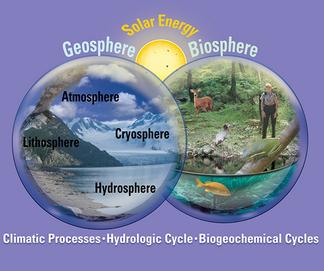
the Geosphere carbon cycle and the Biosphere carbon cycle. The Geosphere carbon cycle operates at very long, slow time scales of thousands to millions of years. Sedimentation, lithification, tectonics and volcanism are important Geosphere processes that convert carbon compounds into new forms.
The Biosphere carbon cycle operates on time scales of seconds up to hundreds of years. Photosynthesis, respiration and combustion are key Biosphere processes that convert carbon compounds into new forms.
PART A: You will trace the pathway of carbon from the atmosphere into trees where carbon can be stored for hundreds to thousands of years.
General Sherman Sequoia, Sequoia National Park.Courtesy: Wikicommons/Jim Bahn
Part A: Trees - The Carbon Storage Experts
Have you ever stood next to a tree and wondered how this tree got to be so big? In California, some Giant Sequoia trees are more than 2000 years old and grow to be over 300 feet tall. General Sherman pictured in the image on the right, is the largest tree in the world by volume and is estimated to weigh over a million kilograms of mass (2,204,622 pounds).
Where does all that mass come from?
Think about the question above as you watch scientists taking measurements of The President, the second largest giant sequoia in this National Geographic Video 'Magnificent Giant Tree: Sequoia in a Snowstorm.'
With a partner, write down ideas of where you think the mass of the Giant Sequoia tree comes from as it grows and then create a class list of all possible ideas.
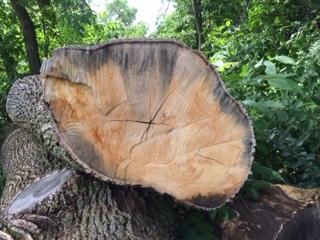
Trees, like all organisms, grow by adding mass (biomass). Carbon is the central ingredient in making that new biomass. Tree biomass is comprised of all parts of the tree; leaves, stems, branches, roots, tree trunks. The biomass of the woody tissue in the tree pictured on the right is made mostly of cellulose, a carbon compound. In a process called carbon fixation, plants transform CO2, an inorganic carbon compoundinto organic carbon compounds.
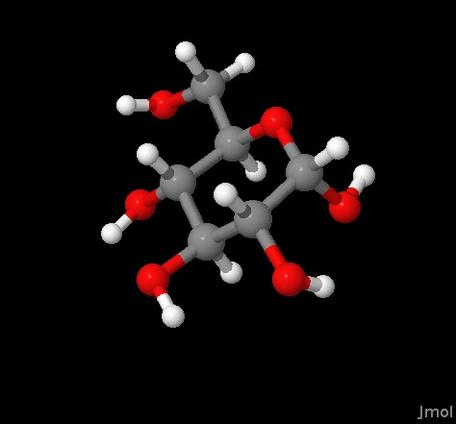
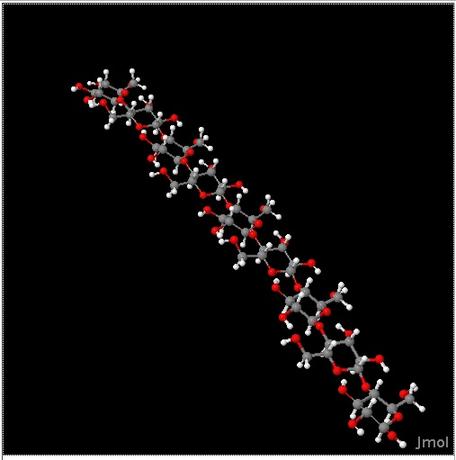
Plants use organic carbon compounds for energy, growth and metabolism. Examine the images of glucose and cellulose pictured below. Then, answer the checking in questions below. NOTE: Carbon atoms are grey, hydrogen atoms are white and oxygen atoms are red. Click on the images for a larger view.
A glucose sugar molecule produced by plants and algae via the process of photosynthesis.
A cellulose molecule. Cellulose is a carbohydrate produced by plants and comprises most of the woody tissue biomass in plants.
Checking In
Carbon atoms cycle throughout the Geosphere and Biosphere as part of millions of different types of carbon compounds
Carbon atoms are continually on the move, cycling into and out of different components of the Biosphere and Geosphere. Carbon atoms do not cycle as single atoms but instead move as part of carbon compounds. Changing from one type of carbon compound to another as carbon cycles and is stored is a key feature of the carbon cycle.
The amount of CO2 trees absorb from air influences climate
Like all plants, trees are an important component of the Earth System biosphere primarily because they absorb so much carbon dioxide from the atmosphere and store the carbon in their biomass. As a greenhouse gas(GHG), carbon dioxide (CO2) plays an important role in regulating Earth's climate. By reducing the amount of atmospheric CO2, trees have the capacity to influence climate.
The amount of carbon stored in biomass depends on the balance of carbon input via photosynthesis and carbon output via respiration
There are three important carbon cycle processes that cycle carbon compounds into and out of trees, and into storage in biomass:
Photosynthesis is the carbon cycle process that moves carbon atoms from the air into trees and all other plants. Carbon atoms move into the biosphere and into most food webs via this process.
Respiration is the key carbon cycle process that moves carbon atoms out of plants into the atmosphere, surrounding soil or water.
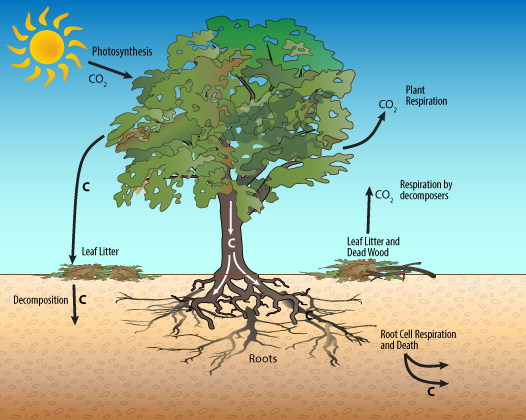
Carbon Cycle of a Single Tree. Credit: Valerie Martin, TERC
Examine the diagram of the carbon cycle of a single tree, pictured on the right.
Take a few minutes to trace where the carbon goes. When you are finished, answer the Checking In questions below.
Checking In
Stop and Think
1: Using the tree diagram above to help you, explain why trees (and all plants) represent a small but complete carbon cycle. Draw your own diagram to help you illustrate your answer.
PART B, you will go outdoors and measure the amount of carbon in a local tree.
Part B: Carbon Storage in Local Trees
Adapted from Janowiak, M.: "The Carbon in Trees" activity from Future Fuels from Forests Teacher Institute. 2009, Northern Institute of Applied Science , Michigan Technological University.
You may have a favorite tree nearby in your own backyard, outside your school or in your neighborhood. How much carbon do you think this tree stores? You can easily determine the amount of carbon stored in your favorite tree using simple materials and calculations.
First, watch forest ecologist Laura Marx describe carbon storage in a Red Oak tree in a Massachusetts forest.
As you watch, write down three facts about carbon storage in trees you think it is important to share with the class before you begin this activity.
As a class, share and discuss the three facts you wrote down about carbon storage in trees. Then, dicuss the following question:
Why should we care about how much carbon a tree stores?
Lab investigation: How Much Carbon is Stored in a Local Tree?
In this activity, you will determine the amount of carbon stored in a local tree. You will develop a set of skills that you can use on many species of trees, from urban trees to trees in the middle of forests. These skills include:
Identifying species names and common names of trees.
Calculating the approximate mass of CO2 taken in by your tree to build its carbon store.
Watch this Vimeo video on how to measure trunk diameter before going outside to select a nearby tree to study. Make note of important instructions. If the video doesn't play, watch here: Trunk Diameter: Learn To Measure on Vimeo
Select a local tree with a circumference of at least 38 cm (15 inches), if possible. Assign your tree a number. NOTE: Each tree should have a different number.
Identify the species and common name of the tree using a tree guide .
Take a picture and/or make drawings of the tree. You may want to include other information such as environmental variables that might impact the growth of the tree (for example, soil type, soil moisture, soil nutrients , amount of light the tree gets, temperature etc.)
Is this species a hardwood or softwood? The resources you used to help identify your tree species should tell you if your tree is a hardwood or softwood. If not, use this resource Hardwood or Softwood?
Determine the diameter (cm) of the tree trunk at 1.4 meters (4.5-4.6 feet) from the ground. Use one of the two following methods:
Use a diameter tape measure to directly measure diameter. Convert to centimeters (cm) if necessary.
Use a regular tape measure or string to measure the circumference of the tree. Convert the circumference measurement to centimeters(cm) if necessary. Divide the circumference(cm) measurement by 3.14(Pi) to calculate the diameter.
Calculate the biomass (M) for your tree. To calculate tree biomass, foresters use a standard allometric equation M=aDb where:
M= above ground dry weight biomass(kg) of the tree
D= diameter measured at 1.4 meters above ground
"a" and "b" are species-specific allometric coefficients. Locate these two coefficients for the common name of your tree on the Allometric Coefficients for Common North American Trees(Microsoft Word 2007 (.docx) 91kB Jan30 15)table.
Calculate the approximate mass of carbon atoms stored in your tree in kilograms(kg). .
A tree's biomass contains carbon atoms in addition to hydrogen, oxygen nitrogen, phosphorus and sulfur atoms. Foresters know that approximately half of a tree's biomass is made of carbon atoms. This value is slightly different in hardwood vs softwood trees. To determine the amount of carbon in your species of tree, choose one of the following:
Multiply tree biomass (M) by 0.521 for hardwood trees =____(kg) of carbon stored
Multiply tree biomass (M) by 0.498 for softwood trees = _____(kg) of carbon stored
Calculate the approximate amount of CO2 your tree absorbed via photosynthesis to create its stored mass of carbon. NOTE: Not all CO2 a tree takes in gets stored as mass. Some returns to the air via respiration.
Scientists have determined that 1 kg of carbon is equivalent to approximately 3.67 kg of CO2. Thus, multiplying the carbon stored (kg) in your tree by 3.67 will give you an approximate measure of CO2 taken in via photosynthesis and stored in the tree.
Checking In
How many kg of CO2 did your single local tree remove from the atmosphere and store in its biomass?
(Optional) Convert the mass of carbon stored in your tree to metric tons. NOTE: Scientists normally use metric tons to quantify carbon storage. Do a simple calculation using this conversion factor (1 metric ton = 1000 kg) or use the worldwide metric calculator.
Discuss
As a class, discuss the following:
After graphing is completed, analyze and discuss the graphs in terms of the following:
interesting patterns that emerge from the data(if any)
amount of carbon stored (sequestered)
amount of CO2removed from the atmosphere by the trees and stored in tree biomass.
What environmental variables, if any, could influence the amount of carbon stored by trees. How?
How might tree carbon storage data and your new skills be useful to your community?
Stop and Think
1: Carbon dioxide (CO2) is a greenhouse gas that naturally warms the atmosphere as part of the greenhouse effect. Unfortunately, the amount of CO2 in the atmosphere has been increasing over the past hundred years. According to scientists, this increase in atmospheric CO2 has caused the average global temperature on Earth to increase by about 0.8° Celsius since 1880. Two-thirds of the warming has occurred since 1975, at a rate of roughly 0.15-0.20°C per decade. (NASA)
Explain how planting and growing more trees could mitigate this warming trend in global temperature.
Carbon is everywhere, in the oceans, in rocks and soils, in all forms of life, and in our atmosphere. Without carbon, life would not exist as we know it. The well-being and functioning of our planet depends on carbon and how it cycles through the Earth's systems.
Carbon is constantly in the news. Have you heard of carbon dioxide and the greenhouse effect? The carbon cycle plays a key role in regulating Earth's global temperature and climate by controlling the amount of carbon dioxide in the atmosphere. The greenhouse effect itself is a naturally occurring phenomenon that makes Earth warm enough for life to exist. Without the greenhouse effect, Earth would be a much colder place. Carbon dioxide is an important greenhouse gas, because it helps Earth's atmosphere to retain heat generated from the Sun. But sometimes, too much of a good thing can have negative consequences. Too much carbon dioxide going into the atmosphere can lead to a planet that gets unnaturally hot.
Since the industrial revolution in the 19th century, carbon dioxide in the atmosphere has risen by 30%. Scientists have shown that this increase in carbon dioxide is a result of human activities that have occurred over the last 150 years, including the burning of fossil fuels and deforestation. Since carbon seems to be connected to everything that matters to us—our climate, our bodies, our ecosystems, the health of our planet—it makes sense for us, scientists and non-scientists alike, to learn as much about carbon and carbon cycle as we can. Only then can we make sensible "carbon decisions" that will impact our future.
What will I learn?
This unit will introduce you to the basics of the carbon cycle. You will learn how the carbon cycle, climate and the abiotic and biotic components of the environment influence each other in many ways. You will learn how carbon moves throughout the different components of the carbon cycle and where carbon is stored in the Earth's system. Using case studies, NASA visualizations, current research, and interactives, you will explore how living things on land, in soils, and in our oceans regulate the carbon cycle. Because carbon, climate and the environment are tightly coupled, you will analyze the effect of carbon dioxide on the Earth's thermostat and our climate. Finally, you will seek possible solutions to a warming climate.
Key Questions
How do the carbon cycle, climate and the environment influence each other?
How does the carbon cycle regulate the temperature of Earth's atmosphere?
Will carbon dioxide continue to rise, and if so, what can we do about it?
On April 20, 2010, the Deepwater Horizon oil rig operating in the Gulf of Mexico exploded and sank. Oil and gas moved up the drilling well-bore onto the deck causing a massive fire. The explosion killed 11 platform workers and badly injured 17 others. Following the explosion and sinking of the rig, oil gushed up from the sea floor unabated for 87 days. An estimated 4.9 million barrels of crude oil spilled into the Gulf of Mexico waters inundating the coastlines of Louisiana, Mississippi and Alabama, and damaging coastal ecosystems and fishing industries.
The oil and gas extracted by the DeepWater Horizon rig had been formed and buried in deep sediments millions of years ago. While coal had been used as a fuel resource since 1000 B.C, it wasn't until the arrival of the Industrial Revolution that coal began to replace wood biomass as the primary source of energy. Today, humans are extracting the three primary fossil fuels - coal, oil, and natural gas - to provide energy for a world population that has exceeded 7 billion. Fossil fuels are made of hydrocarbons. In this section of Lab 1, you will investigate how the combustion of fossil fuel hydrocarbons is changing the chemistry of the atmosphere.
Burning hydrocarbons releases energy, and CO2 as a by-product
Methane, a small hydrocarbon molecule, is found in natural gas. Methane can also occur naturally in environments such as marshes, bogs, and deep ocean.
The Deep Horizon rig was drilling for crude oil (petroleum) deep within bottom sediments in the Gulf of Mexico. Crude oil is a mixture of several different chemicals which can be refined into hydrocarbon products such as such as motor oil, gasoline, jet fuel, diesel fuel, and heating oil. If you drive a car, heat your home, turn on a light, or enjoy a good backyard barbecue, the energy you are using most likely comes from burning fossil fuel hydrocarbons, a process called combustion.
Energy is stored in the chemical bonds that hold the carbon and hydrogen atoms together. When the atoms are rearranged in the combustion reaction, bonds are broken and new bonds formed, releasing energy. The chemical energy stored in these bonds originated from solar energy used by plants to power photosynthesis. During photosynthesis, plants transform solar energy to biochemical energy which becomes stored in the bonds of glucose molecules and other carbon compounds made by plants.
Are humans changing the chemistry of the atmosphere?
The video you just watched makes the claim that when humans burn fossil fuels, we release CO2 to the atmosphere causing the atmosphere to become warmer. However, the video provides no data as evidence to support this claim. As a matter of fact, some people on the Internet have claimed that humans have no role in rising CO2and instead blame the rise on natural events such as volcanic outgassing. Providing evidence for a claim is a critical component of science. To that end, you will analyze data from a series of graphs, a NASA animation of CO2 emissions and a video presentation given by geoscientist Dr. Richard Alley. A
Graph 1: Emissions of carbon dioxide to the atmosphere from burning fossil fuels since 1880- the beginning of the Industrial Revolution. Emissions are measured in millions of metric tons of carbon. Figure by Greg Fiske, Woods Hole Research Center
Click on the links below to view the graphs and watch the video.
Graph 1: Illustrates the amount of CO2emissions moving into the atmosphere from the combustion of the three most important fossil fuels: oil, gas, and coal from 1880-2004.
Graph 4: Go to NASA's Vital Signs for Global Land-Ocean Temperature Index. This data represents temperatures that are above or below a 30 year average of temperature measurements taken from 1950-1980.
Graph 5:1000 years of Fossil Fuels allows you to compare trends in three datasets: fossil fuels, CO2 and temperature.
Video 1: NASA, a year the life of Earth's CO2 . In this video animation, NASA scientists have compressed a year's worth of CO2 data into one year. Can you identify the three areas of the world producing the most CO2?
Stop and Think:
1: Describe how combustion can move carbon atoms from being stored deep in the ground to the atmosphere. 2: Identify and explain at least one piece of evidence supporting or refuting the claim that humans are changing the carbon chemistry of the atmosphere.


![[creative commons]](https://serc.carleton.edu/images/creativecommons_16.png)


 Carbon Cycle of a Single Tree. Credit: Valerie Martin, TERC
 Methane, a small hydrocarbon molecule, is found in natural gas. Methane can also occur naturally in environments such as marshes, bogs, and deep ocean.


 Show caption